School of Pharmaceutical Sciences, Wuhan University
Research Project
6
20 L
~90 Days
3
Co-Culture-Driven Modulation of Secondary Metabolites in the Cicada-Egg Symbiotic Fungus CL-1
A team-based undergraduate research project on activating cryptic fungal metabolism through co-culture, scale-up fermentation, chromatographic purification, and NMR-based structure confirmation.
Under monoculture conditions, the cicada-egg symbiotic fungus CL-1 shows a relatively narrow secondary-metabolite profile and limited chemical diversity. This project investigates whether co-culture with marine-derived fungi can activate silent biosynthetic pathways, reshape the metabolite spectrum, and create a practical discovery route toward structurally interesting and potentially bioactive compounds. By combining co-culture screening, large-scale fermentation, chromatographic fractionation, and structure confirmation, the study builds a complete workflow for metabolite induction and natural-product exploration.
This portfolio entry documents a collaborative undergraduate innovation project in which I served as the second project lead.
co-culture pairs screened
scale-up fermentation
static cultivation
confirmed compounds
Research narrative viewer
01 / Co-Culture Innovation
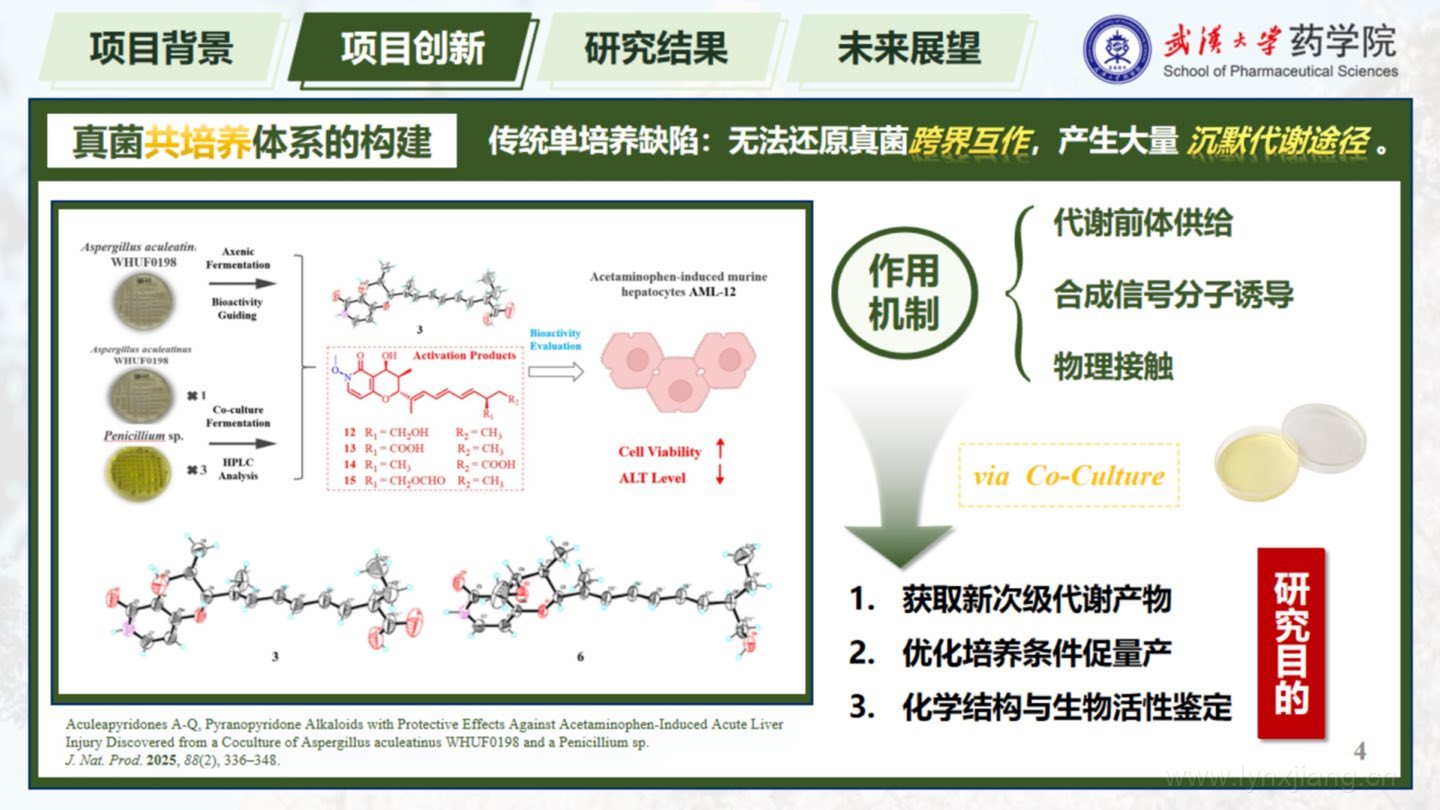
Why Co-Culture Is the Core Strategy
This section explains the conceptual innovation of the project: instead of relying on monoculture, the study uses fungal co-culture to mimic ecological interaction, reactivate silent pathways, and expand the chemical output of CL-1.
PPT 04
1 of 1 in Co-Culture Innovation
Why Co-Culture Is the Core Strategy
The conceptual starting point of the project is that monoculture often fails to reproduce the ecological signals that regulate fungal secondary metabolism. For CL-1, this creates a major bottleneck: valuable biosynthetic pathways may remain silent under standard laboratory conditions. Co-culture offers a practical workaround by reintroducing interspecies interaction and creating the chemical, nutritional, and signaling pressure needed to trigger new metabolite production.
In this project, co-culture is not treated as a decorative add-on but as the main experimental engine. The workflow is built around three linked goals: obtaining induced secondary metabolites, optimizing conditions for scale-up production, and moving from isolation toward structural and bioactivity-oriented characterization.
- Co-culture restores interaction signals absent in monoculture.
- Silent or weakly expressed pathways may become chemically visible.
- The project connects induction, scale-up, and identification in one workflow.
- Innovation lies in turning ecological interaction into a discovery strategy.
Project innovation comes from using fungal interaction itself as the trigger for chemical diversification.
Co-culture turns pathway activation into an experimentally testable design choice.